Manufacturing: Passing Through Input Costs Without Losing Contracts
Rise-and-fall mechanisms, index-linked pricing and the conversations that make them acceptable to customers.
Rise-and-fall mechanisms, index-linked pricing and the conversations that make them acceptable to customers.
Fuel surcharges, rise-and-fall clauses and the customer conversation — how operators are passing through a 33c/L swing.
Some clients cost more to serve than they pay. Here is how to identify them properly, and three ways to exit that leave the relationship intact.
Pricing is the highest-return lever available to an Australian business and the least used. This is the whole discipline — the arithmetic, the psychology, and where to start.
Hourly billing caps your income at your capacity and punishes you for getting faster. Three alternatives and how to transition without losing clients.
Australian retail is squeezed from three directions at once. Here is how to find margin without reaching for the discount lever that caused half the problem.
Most trade businesses set rates by looking at competitors. Here is how to build one from actual cost recovery — including the billable-hours problem that sinks most of them.
Australian customers are hyper-aware of price rises in 2026. That makes how you raise them matter more than whether you do. Segmentation, timing, and three scripts you can send.
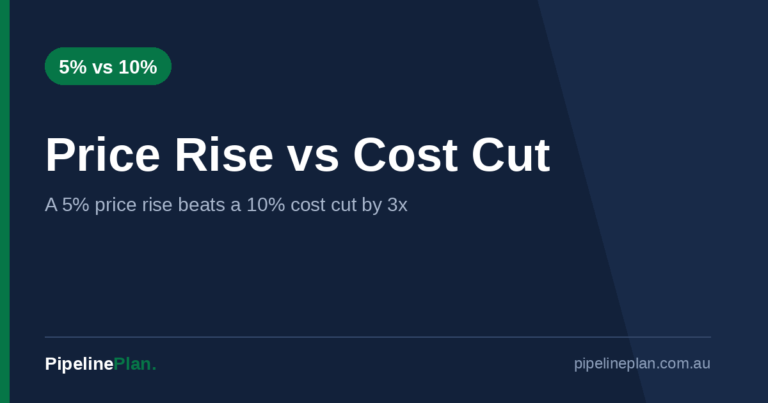
On a $1m business at 10% net margin, a 5% price rise adds $50,000 to profit. A 10% cut to discretionary costs adds about $15,000. Same business, same year, three times the result.
Nine levers move profit. Most Australian businesses work them in almost exactly the wrong order. Six questions to find out which one you should be on.